What Does Gene Fear Will Never Come Again A Friend Like Finny Gypsy Summer Peace His Innocence
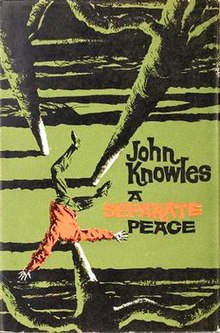 Get-go edition | |
| Writer | John Knowles |
|---|---|
| Country | United States |
| Language | English language |
| Genre | Realism |
| Publisher | Secker & Warburg |
| Publication date | 1959 |
| Media type | Print (hardback and paperback) |
| Pages | 236 |
| ISBN | 978-0-7432-5397-0 |
A Split Peace is a coming-of-age novel past John Knowles, published in 1959. Based on his earlier short story "Phineas", published in the May 1956 upshot of Cosmopolitan, it was Knowles's starting time published novel and became his best-known piece of work. Set against the properties of World War II, A Separate Peace explores morality, patriotism, and loss of innocence through its narrator, Gene.
Plot summary [edit]
Gene Forrester returns to his onetime prep school, Devon (a thinly veiled portrayal of Knowles's alma mater, Phillips Exeter Academy),[1] xv years after he graduated, to visit ii places he regards as "fearful sites:" a flight of marble stairs, and a big tree past the river. Showtime of all, he examines the stairs and notices that they are fabricated of marble. Then he goes to the tree, which brings back memories of his time as a educatee at Devon. From and then on, the novel follows Gene's description from the summer of 1942 to the summer of 1943. In 1942, he is sixteen and living at Devon with his all-time friend and roommate, Phineas (nicknamed Finny). Globe War Two is raging and has a prominent effect on the story's plot and characters.
Despite existence opposites in personality, Factor and Finny are surprisingly close friends. Gene'due south serenity, introverted, intellectual personality is a character foil for Finny's extroverted, carefree athleticism. 1 of Finny's ideas during their "gypsy summer" of 1942 is to create a "Super Suicide Lodge of the Summertime Session," with Cistron and himself every bit charter members. Finny creates a rite of initiation by having members bound into the Devon River from a big tall tree.
Cistron and Finny'due south friendship goes through a menstruum of one-sided rivalry during which Gene strives to outdo Finny scholastically as he believes that Finny is trying to outdo him athletically. The rivalry begins with Factor's envy toward Finny. It climaxes and ends when as Finny and Gene are nearly to jump off the tree, Gene impulsively jostles the branch that they're on, causing Finny to autumn and shatter his leg, which permanently cripples him. Because of his blow, Finny learns that he will never over again exist able to compete in sports, which are most dear to him.
Finny's "accident" inspires Gene to think more than similar his friend to become a meliorate person, free of green-eyed. The residual of the story revolves around Gene's attempts to come to grips with who he is, why he shook the branch, and how he will go on. Gene feels so guilty that he somewhen tells Finny that he caused the fall. At kickoff, Finny does not believe him, but then comes to feel extremely hurt.
Globe War Ii before long occupies the boys' time, with young man student Brinker Hadley rallying the boys to assist the war effort and Factor'due south quiet friend Leper Lepellier joining the Ski Troops and becoming severely traumatized by what he sees.
During a meeting of the Golden Fleece Debating Society, Brinker sets upwards a testify trial of sorts and, based upon his shaking of the branch, accuses Factor of trying to kill Finny. Faced with the bear witness, Finny leaves shamefully earlier Factor's deed is confirmed. On his mode out, Finny falls downwards a flight of stairs, the same ones that Gene visited at the beginning of the novel, and over again breaks the leg that he had shattered before. Finny at first dismisses Gene'southward attempts to apologize, simply he soon realizes that the "accident" was impulsive and not premeditated or based on anger. The 2 forgive each other.
The side by side twenty-four hour period, Finny dies during the functioning to set the bone when bone marrow enters his bloodstream during the surgery.
After they graduate, Factor and Brinker enlist in the Navy and the Declension Guard. Gene observes that many people lash out at others to protect themselves from their own insecurities. The only person he knew who did non do that was Finny, the but person Cistron knew to be truly honest, and the only person he knew never to have an internal state of war to fight. Back in the present, an older Gene muses on peace, war, and enemies.
Characters [edit]
- Gene Forrester: A Separate Peace is told from Factor's signal of view. He focuses on and succeeds at academics. He envies his roommate and best friend Finny'southward graceful, easy athleticism and social prowess but also admires these very features. Cistron is from "three states from Texas;" being somewhat unaccustomed to Northeastern culture, he is an outsider of sorts at Devon. Gene shakes a branch which causes his all-time friend, Finny, to fall from a tree and break his leg, but it is cryptic whether the move is deliberate or not.
- Phineas (Finny): Factor's friend and roommate; an incorrigible, good-natured, carefree, able-bodied, daredevil type. In Gene's opinion, Finny can never leave anything well enough alone and tin always become away with annihilation. He always sees the best in others, seeks internal fulfilment costless of accolades, and shapes the world around himself to fit his desires. He is a prodigious athlete, who succeeds in every sport until his leg is shattered in his fall from the tree.
- Brinker Hadley: Brinker is a classmate and friend of Gene and Finny. He ceaselessly strives for order during the Winter Session at Devon. Brinker wants to get to the lesser of Finny's accident, merely information technology is unclear if he intended for the investigation to be a practical joke. He organizes the "midnight trial" to confront and to accuse Gene of causing Finny's blow. During the questioning of Finny past Brinker, Finny changes the story to make Gene announced innocent of his actions in the tree. Finny cites Lepellier as an unreachable witness. Brinker ultimately reconciles with Gene, who appears to forgive him both for his role in Finny'due south injury and for the trial. Brinker was based on Knowles' Phillips Exeter Academy classmate and friend Gore Vidal.[2] [3]
- Elwin "Leper" Lepellier: Leper is Finny and Gene'southward friend and a key member of the Super Suicide Society of the Summer Session. He is the commencement student in his class to enlist in the military. Late in the novel, Leper goes insane from the stress of his enlistment in the army. He is a witness at Gene's "trial" and testifies that Factor was responsible for Finny's fall.
Themes, motifs and symbols [edit]
A Separate Peace contains many themes, motifs and symbols, which occur throughout the book. Some of them are present throughout the book, like the tree Finny falls off and the presence and significance of sport. Other themes be as part of Factor'south consciousness and his relationship with Finny, such as the threat of codependency and the cosmos of inner enemies. In add-on, at that place are many ambiguous factors that remain unresolved, such every bit the reliability of Gene as a narrator and whether Factor was responsible for the autumn.[4]
Co-dependency and identity [edit]
The cardinal human relationship between Factor and Finny is a model of codependency. After the fall, the two become reliant on each other for fulfilment. Gene's submissive nature leads to him defective a stiff identity without Finny. Finny, with his free, sport-loving spirit, can only be fulfilled by experiencing the sport through Gene afterward the fall. That is furthered past the characters' notion that World War II is merely a conspiracy, which creates a private illusion for both Finny and Gene to exist in together. Towards the end of the book, after Finny's death, Gene notes that he feels Finny's funeral is his own, equally so much of his identity rests upon Finny.[4]
Athletics and blitzball [edit]
Athletics comprise a key part of Finny'southward personality. He views them as an expression of accomplishment and believes there are no winners or losers. That is epitomized by Finny's breaking of the schoolhouse swimming record, which he does not experience the need to publicise, and Blitzball, a game that Finny spontaneously invents that has no winners or losers, which Finny excels at every bit it requires pure athleticism rather than focusing on defeat of opponents.[iv]
Summer and Winter Sessions [edit]
The Summertime Session at Devon High School is divers by freedom, lack of rules and lilliputian academic study. This symbolises innocence and youth, which is "lost" when Finny falls from the tree, giving lead to the Wintertime Session. The Wintertime Session is defined as the polar contrary of the Summer Session: tight rules, rigorous study, little freedom and a common cold and unforgiving atmosphere. The Sessions correspond the shift from carefree youth to adulthood and maturity, which occurs throughout the novel.[four]
Finny's fall [edit]
Finny'southward fall from the tree marks the climax of the novel. It is both a literal and a symbolic fall. The literal fall has a knock-on effect of no sports for Finny, which leads to a loss of independence and identity. The symbolic fall represents a fall from innocence and from youth, and the commencement of the end of Finny and Gene's friendship. The fall can be interpreted equally having biblical allusions; similar Adam and Eve, Finny and Gene existed in a carefree, idyllic setting, epitomized by innocence (like Eden), which is tainted by a force of darkness (the ophidian or Gene'due south growing resentment) and so is shattered by a fall from innocence (the fall from the tree).[4]
Implied homoerotic undertones [edit]
Various parties accept asserted that the novel implies homoeroticism between Gene and Finny, including those who endorse a queer reading of the novel and those who condemn homosexuality every bit immoral. For example, the book was challenged in the Vernon-Verona-Sherill, NY School Commune (1980) as a "filthy, trashy sex activity novel"[5] despite having no substantial female person characters and describing no sexual activity.
Though frequently taught in U.s.a. high schools, curricula related to A Separate Peace typically ignore a possible homoerotic reading in favor of engaging with the book as a historical novel or coming-of-age story.[vi] Knowles denied whatever such intentions, stating in a 1987 newspaper interview:
Freud said whatsoever strong relationship between two men contains a homoerotic element... If so, in this example, both characters are totally unaware of it. It would accept inverse everything, it wouldn't have been the aforementioned story. In that fourth dimension and place, my characters would have behaved totally differently... If there had been homoeroticism between Phineas and Gene, I would have put it in the book, I clinch y'all. Information technology simply wasn't there.[vii]
Adaptations [edit]
The novel has been adjusted into two films of the aforementioned proper noun. The first, starring Parker Stevenson every bit Gene and John Heyl every bit Finny, with a screenplay by Fred Segal and John Knowles, was released in 1972.[viii] The second, directed past Peter Yates, with a screenplay past Wendy Kesselman, was released in 2004.[9]
Awards and honors [edit]
- 1960 New York Times bestseller (Fiction)
- 1961 William Faulkner Foundation Laurels, inaugural winner
- 1961 National Book Award finalist (Fiction)
References [edit]
- ^ Carragher, Bernard (Oct 8, 1972). "There Really Was a Super Suicide Society". The New York Times . Retrieved 4 December 2020.
- ^ Woo, Elaine (2001). "John Knowles, 75; Wrote 'A Split Peace'". Los Angeles Times . Retrieved 28 Apr 2021.
- ^ Cardno, Catherine (August 2, 2012). "Gore Vidal and John Knowles' A Carve up Peace". Instruction Week. Retrieved 28 April 2021.
- ^ a b c d e A separate peace : John Knowles. Knowles, John, 1926-2001., SparkNotes LLC. [New York, NY]. ISBNone-4114-6979-eight. OCLC 856977904.
{{cite book}}: CS1 maint: others (link) - ^ "American Library Association – Banned and/or Challenged Books from the Radcliffe Publishing Course Top 100 Novels of the 20th Century". Retrieved 2014-xi-17 .
- ^ Tribunella, Eric L. (2002). "Refusing the Queer Potential: John Knowles's A Separate Peace". Children's Literature. 30: 81–95. doi:10.1353/chl.0.0760.
- ^ "SunSentinel – Knowles Now Thirty Years After He Wrote A Separate Peace, John Knowles Is Coming To South Florida To Teach Artistic Writing -- Even Though He Says, "Everybody Knows You lot Can't Teach Anyone To Write."". 1987-03-15. Retrieved 2014-eleven-17 .
- ^ Canby, Vincent (September 28, 1972). "Picture show Review – A Dissever Peace". The New York Times.
- ^ "A Separate Peace (2004)". IMDb . Retrieved 29 Oct 2019.
External links [edit]
-
 Quotations related to A Separate Peace at Wikiquote
Source: https://en.wikipedia.org/wiki/A_Separate_Peace
0 Response to "What Does Gene Fear Will Never Come Again A Friend Like Finny Gypsy Summer Peace His Innocence"
Post a Comment