what did king solomon do to make israel a strong and rich nation?
(1-1) Introduction
Many kings ascended the throne of State of israel from the time of Saul to the dissolution of both the Northern Kingdom and the Southern Kingdom. None of these kings, nonetheless, obtained the ability and prestige that Solomon did. Near a one thousand years earlier Solomon, Abraham had been promised that his seed would receive the country of Canaan for their inheritance, including territory equally far north as the Euphrates River (meet Genesis 12:7; 13:fifteen; fifteen:eighteen). But not until Solomon's fourth dimension was this promise fully realized. Solomon extended the domain of State of israel from the Red Body of water on the south to the Euphrates River on the north. The golden age of State of israel, started under King David, continued nether Solomon. During the forty years that Solomon ruled as king of Israel, there was peace and unity throughout his vast domain.
At the beginning of his reign, Solomon loved the God of State of israel and covenanted with God that he would walk in obedience throughout his administration equally king of State of israel. Solomon was promised wisdom, riches, honor, and long life if he would continue in righteousness before the Lord. The hope was fulfilled. During his life, Solomon became famous for his wisdom. Groovy men and women from many nations came to hear him and test his agreement and knowledge. Solomon also acquired great wealth, and there were said to exist no kings in all the world who could compare to him. Under Solomon's reign Israel reached her greatest bespeak as a nation—accolade, wealth, power, and respect were hers considering of the administration of her greatest king.
Nevertheless, at the end of Solomon'south reign, Israel became temporally and spiritually bankrupt. Deterioration and strife were everywhere. Within a yr of Solomon's death, the land was divided into two kingdoms, and the course of Israel'due south history was permanently contradistinct. What deportment or events led the nation from such heights to such depths? Yous will find the answers in the outset volume of Kings. As you read, try to identify the events that brought well-nigh the decline of State of israel.
Notes and Commentary on one Kings 1–11
(one-2) 1 Kings 1. How Could Adonijah and Solomon Both Accept Claim to the Throne of Israel?
According to the customs of succession, Adonijah could well have been the heir to the throne of David. Adonijah was the fourth son of David (run across 2 Samuel 3:4). 2 of his older brothers, Amnon and Absalom, were already dead, and a third, Chileab, is not mentioned in the text except for the account of his birth.
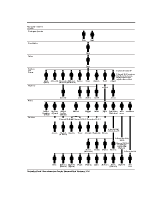
The family of David. Chart redrawn from Douglas, Illustrated Bible Dictionary, ane:367
David's old age and feeble status (run into 1 Kings 1:1–4) evidently convinced Adonijah that information technology was time to prove the people that he was the successor to the throne. His deportment were thus designed to convince the people of his correct and to create a base of operations of popular support that would consolidate his position. He set up a imperial processional (run across 5. five); sought the support of important people, including Joab, the commander of the military, Abiathar, the loftier priest, the other princes of the courtroom, and David'southward personal staff (see vv. vii, 9); and prepared a great banquet (run across v. 9). He deliberately excluded those loyal to Solomon as the successor, including Zadok, another important priest; Benaiah, one of the military commanders (perhaps second in command to Joab); the "mighty men" (v. 8), who were probably David'southward personal body guards; and the prophet Nathan.
Adonijah's plan was thwarted, all the same, when Nathan heard what Adonijah was doing and reported it to Bath-sheba, Solomon's female parent. His warning to her that her life too as Solomon'south life was in danger (see v. 12) illustrates one of the problems with a monarchical organization of government. Because of the contest that typically existed in the regal family itself, the new king often assassinated all his brothers and other possible heirs who might pose any threat to his rule.
Moving swiftly, Bath-sheba and Nathan joined together (see five. xi) to bring Adonijah's manipulations to the attention of King David. When David learned that Adonijah sought to take the throne, he quickly appointed Solomon every bit co-regent. They ruled together until David died.
Although simply twenty years of age, Solomon, similar David and Saul before him, was anointed to his kingship past a rightful priest and by the prophet (see vv. 34, 39). To clearly prove the people that Solomon was David's pick and the Lord's, David commanded that the inauguration of his co-regent take place immediately. He allowable that Solomon be placed on his (David's) mule to ride in procession to Gihon in the traditional way that a king made his triumphal entry into a metropolis (encounter J. R. Dummelow, ed., A Commentary on the Holy Bible, p. 693; compare with Jesus' triumphal entry into Jerusalem recorded in Matthew 21:ane–xi). The people responded joyously and accepted Solomon as their new male monarch (see 1 Kings ane:39–twoscore).
Thus, in 1 quick and decisive motion, David cut off Adonijah's attempts to usurp the throne, and Solomon was established every bit king. One can easily imagine why those at Adonijah'southward feast were struck with fear and hastened to desert Adonijah'south presence. They were caught in the midst of what bordered on treason against the new rex, and they were anxious to disassociate themselves from Adonijah.
Now information technology was Adonijah's life that was in danger. Non only was he a potential rival to the throne, but he had been evidently making an open try to preempt Solomon's claim. And then, as presently equally he learned of the enthroning of Solomon, Adonijah fled non to his home, but immediately to the heights of Mountain Moriah just above the urban center of David. Here an altar of sacrifice had been set upward past David. The horns of the altar of sacrifice were considered a sanctuary where a person could cling until his example was investigated and tried (see Exodus 21:13–xiv). In that location Adonijah waited, hoping for some indication of Solomon's charity toward him, which was granted (encounter one Kings 1:50–55; come across also One-time Attestation Educatee Transmission: Genesis–two Samuel [religion 301, 2003], pp. 167, 268 for a detailed explanation of why the horns of the altar were seen as a identify of refuge).
(1-three) 1 Kings i:38. Who Were the Cherethites and the Pelethites?
The Cherethites were "a people who were settled alongside the Philistines in southern Palestine [see 1 Samuel 30:14; Ezekiel 25:sixteen; Zephaniah 2:5]. In the reign of David they formed, with the Pelethites, his private babysitter under the command of Benaiah the son of Jehoida [see 2 Samuel 8:eighteen; 20:23; i Chronicles 18:17]. They remained loyal to him through the rebellions of Absalom [encounter 2 Samuel xv:18] and Sheba [see 2 Samuel twenty:7], and were present when Solomon was anointed for kingship [see 1 Kings ane:38, 44]." (J. D. Douglas, ed., The New Bible Dictionary, s.5. "Cherethites.")
(1-4) 1 Kings 2:1–9. David's Last Instructions to His Son Solomon
David charged his son to keep all the commandments of God, to written report the law, and to practise righteous judgment upon the people. Solomon was also instructed concerning some of David'southward enemies equally well every bit some of his friends.
Start Kings does not record the large aggregation of regime administrators and armed services commanders that David chosen together when he sensed that his death was well-nigh; even so, the historic gathering is recorded in 1 Chronicles 28:1–29:24. At this conference David performed iv great services: (ane) he gained the support of the people for the completion of the temple; (ii) he presented a vast treasure for the temple; (three) he publicly turned over to Solomon the plans for the temple and disclosed that they had been given to him past divine revelation; and (4) he succeeded in having Solomon crowned and anointed a second time when the people of every tribe were officially represented and could declare their loyalty.
(ane-5) 1 Kings ii:ii–3. "Be Thou Stiff … Shew Thyself a Man"
This plea for manhood and force is a familiar Sometime Attestation theme. It was Moses' last counsel to Joshua (see Deuteronomy 31:6–7, 23). The Lord gave Joshua the same encouragement (encounter Joshua 1:5–9). This advice was given to Solomon repeatedly. The courage to obey the police was just as much a part of the plea as to take physical courage.
(1-half-dozen) 1 Kings 2:5–half dozen. Why Didn't David Punish Joab Sooner?
Joab, out of jealousy and fear of losing his position equally commander of the armies of State of israel, had murdered Abner (run into 2 Samuel 3:27) and Amasa (come across 2 Samuel xx:10).
Commentators accept noted that "David ought to have punished these two crimes; but when Abner was murdered, he felt himself too weak to visit a man similar Joab with the punishment he deserved, as he had only but been anointed rex, and consequently he did nada more than invoke divine retribution upon his head [meet 2 Samuel 3:29]. And when Amasa was slain, the rebellions of Absalom and Sheba had crippled the power of David too much, for him to visit the deed with the punishment that was due. But every bit king of the nation of God, information technology was not correct for him to let such crimes to laissez passer unpunished: he therefore transferred the penalization, for which he had wanted the requisite power, to his son and successor. … 'Practise co-ordinate to thy wisdom ("mark the proper opportunity of punishing him"—Seb. Schmidt), and let not his grayness hair go down into hell (the region of the dead) in peace (i.e. unpunished)' [i Kings 1:vi]. The penalty of and so powerful a human being as Joab the commander-in-main was, required great wisdom, to avoid occasioning a rebellion in the army, which was devoted to him." (C. F. Keil and F. Delitzsch, Commentary on the Old Testament, 3:1:29.)
(1-seven) 1 Kings 2:7–8. Who Were Barzillai and Shimei?
Barzillai and Shimei both lived at Mahanaim. Shimei, instead of showing kindness to David when he fled from Absalom, threw rocks at him and cursed him (see 2 Samuel 16:5–eleven). Barzillai, however, showed neat kindness to David and those who had fled with him by providing them with nutrient and clothing. David asked Solomon to provide for the family of Barzillai as a payment for his kindness (see 2 Samuel 17:27–29; 19:31–38).
(1-8) i Kings ii:17–22. Why Was Solomon Upset by Adonijah'due south Asking?
"Among Eastern nations the wives and concubines of a deceased or dethroned king were taken past his successor [run into 2 Samuel 12:8; 16:21–22]; and and then Adonijah'due south asking for Abishag was regarded as tantamount to a claim on the throne" (Dummelow, Commentary, p. 212).
Solomon knew and understood this law, equally 1 Kings 2:22 makes clear. At first it may seem puzzling that Bath-sheba would take Adonijah's request to Solomon since she almost certainly knew and understood this law. Perchance she, knowing how Solomon would react, recognized an opportunity to rid Solomon of the threat that Adonijah continued to be to the throne of Israel. Solomon did react rapidly, for this was the second time Adonijah had attempted to accept the throne by subtlety.
(1-9) i Kings 2:23. Adonijah Had Spoken "confronting His Ain Life"
Solomon meant that Adonijah's request was either treason or a plan to commit treason and was therefore worthy of death. (Note i Kings ii:15, which records that Adonijah knew that the Lord had given the throne to Solomon.)
(1-10) 1 Kings 2:26–36. Were Abiathar and Joab All the same Conspiring against Solomon?
Abiathar and Joab were nevertheless conspiring to put Adonijah on the throne (come across one Kings 2:22). Solomon banished Abiathar from Jerusalem and took from him the office of high priest in Israel. Abiathar was a great-grandson of Eli, who was both priest and gauge in Israel, and the concluding of his descendants to hold a priestly office. This penalization and restriction of Abiathar fulfilled the prophecy announced to Eli by the Lord (run across 1 Samuel ii:31–36).
Abiathar probably escaped with the punishment of exile only because Solomon was reluctant to execute a high priest. Joab, nevertheless, was a much more unsafe enemy because he had allowable the army. There was no question concerning Joab's guilt. Considering of the murders he had committed, he was indeed worthy of decease (see Exodus 21:12–14). Thus, he had no right to merits the sanctuary of the chantry, and Solomon was not obligated to honor his claim to sanctuary.
(1-11) 1 Kings 2:35. Benaiah
Benaiah succeeded Joab equally captain of the host, the tiptop military position in the kingdom under the king.
(ane-12) 1 Kings 2:36–44. The Penalization of Shimei
Continuing to follow the final counsel of his father (come across Notes and Commentary on 1 Kings 2:seven–eight), Solomon now undertook to punish Shimei. At first this penalty may seem vindictive on David's part and roughshod for Solomon to follow through with information technology, since all Shimei had washed was to curse David and throw rocks at him (see two Samuel 16:5–11). At that time, however, David'southward kingdom was rent by civil state of war. Shimei's activity was therefore equivalent to treason confronting the government.
There may have been an boosted reason for David's counsel to Solomon. Shimei was from Bahurim, which was a short distance east of Jerusalem. The Ammonites and Moabites who lived beyond the River Jordan were traditional enemies of Israel. To accept a known enemy of the crown in a city where the Ammonites and Moabites could easily go to conspire with him would have provided future opportunity for treason. This situation may explain David's counsel.
Solomon'due south handling of Shimei was merely and tolerant. He could take had Shimei executed by royal social club. Instead, Solomon brought him to Jerusalem and made him swear on oath that he would not cross the Beck Kidron, the eastern boundary of Jerusalem. This brake lends further back up to the thought that Solomon did non desire Shimei collaborating with the eastern enemies of Israel.
Three years subsequently, considering Shimei violated his adjuration, Solomon had him executed. Keil and Delitzsch noted that "this punishment was also just. Every bit Solomon had put Shimei's life in his own hand by imposing upon him confinement in Jerusalem, and Shimei had promised on adjuration to obey the king's command, the breach of his oath was a crime for which he had no excuse. There is no strength at all in the excuses which some commentators adduce in his favour, founded upon the money which his slaves had price him, and the wish to recover possession of them, which was a right one in itself. If Shimei had wished to remain faithful to his oath, he might have informed the male monarch of the flight of his slaves, take entreated the king that they might be brought back, and have awaited the king's decision; only he had no right thus lightly to break the hope given on oath. Past the alienation of his oath he had forfeited his life. And this is the kickoff thing with which Solomon charges him, without his being able to offering any alibi; and it is not till afterwards that he adduces every bit a 2nd fact in confirmation of the justice of his procedure, the wickedness that he practised towards his begetter." (Commentary, 3:ane:27.)
(1-13) 1 Kings 2:46. Why Was Benaiah the Executioner?
The ground forces was also the police power. Therefore, by virtue of his function every bit helm of the host, executions were Benaiah's responsibleness. If he were sent, the task was sure to be done.
Equally long equally Israel remained free and under the Lord's directly influence, they did non have prisons. Criminals were punished by death for specified crimes. Otherwise, they were required to brand restitution to the person harmed. Sometimes they were placed nether firm arrest on their own award, as was Shimei, or they were banished.
(1-fourteen) 1 Kings three:ane. Why Did Solomon Have a Girl of the Pharaoh to Married woman?
Early in his reign Solomon elected to marry the daughter of the Egyptian pharaoh. Since Israel had imposed its sovereignty throughout the region, Solomon plainly considered information technology important to neutralize whatever hostility on the function of Egypt, for Arab republic of egypt had been accepted to using Canaan as a base for armed forces operations. Marriages betwixt royal families were often politically motivated; such a wedlock was a mode of signing a treaty between two countries. Nevertheless, the union of Solomon to the daughter of the pharaoh showed a lack of faith in the Lord, who had promised to defend Israel and fight her battles (encounter Deuteronomy 20:4; Joshua 23:ten). Afterward, this marriage and other marriages to foreign wives proved to exist a major factor in the downfall of Israel, for Solomon began worshiping the faux gods of these other nations and was condemned past the Lord (see 1 Kings 11:1–9).
(1-15) one Kings iii:4. Why Did Solomon Become to Gibeon to Offer Sacrifice?
The tabernacle congenital past Moses was at this fourth dimension located in Gibeon along with the bully altar upon which sacrifices had been offered since the days of Moses. That is why Solomon went to Gibeon to offer sacrifices (run across ane Chronicles 21:29; ii Chronicles 1:two–3).
(1-xvi) 1 Kings iii:5–28. What Was Important nigh Solomon's First Heavenly Vision?
Solomon approached the Lord every bit a humble, obedient retainer, and he was rewarded for his meekness with a wise and understanding heart. Perhaps no other person was ever given a greater gift of wisdom. Solomon was charged to proceed the Lord'southward commandments and statutes so that the Lord might lengthen his days every bit king.
(ane-17) 1 Kings three:14. Why Did the Lord Praise David's Righteousness When He Had Violated the Law of Chastity and Had Caused Uriah's Murder?
There are numerous places in the historical books where David is held up every bit an example of one who was pleasing in God's sight. The Prophet Joseph Smith corrected each of those references to show that David was being used by the Lord as an case of what David's successors should non do. For example, in the Joseph Smith Translation 1 Kings 3:14 reads: "And if thou wilt walk in my ways to proceed my statutes, and my commandments, then I will lengthen thy days, and grand shalt not walk in unrighteousness, as did thy father David."
In the Male monarch James Version, one Kings eleven:4records that Solomon's heart "was not perfect with the Lord his God, as was the heart of David his father." The Prophet corrected the passage to read that Solomon's heart "was non perfect with the Lord his God, and information technology became equally the heart of David his father" (JST, 1 Kings 11:iv; see also 1 Kings xi:6, 33–34, 38–39; 14:8; 15:3, 5, 11; compare JST).
Solomon'south prayer for an "understanding heart" (1 Kings 3:9) was surely granted, as the incident of the 2 harlots demonstrates. The luminescence of Solomon's strategy is seen when 1 reflects that the woman who was willing to give up the baby rather than see it killed would be the all-time mother to the child, whether she was the natural mother or not.
(ane-18) 1 Kings 4:1–25. How Did Solomon Organize the Authorities to Give Himself Greater Command over the Kingdom?
"Upon his accession to the throne, Solomon made the start of several administrative changes: he created three new offices in his cabinet. David had governed his new empire almost single-handedly, needing only a commanding general, a primary scribe and a few secretaries. To this bones staff Solomon added Ahishar, who 'was in charge of the palace.' He would serve equally prime minister, second only to Solomon in power. Adoniram was named the master of forced labor—for Solomon had a tremendous building program in mind and no way to begin it without a steady supply of workers. Adoniram would supervise both foreign slave laborers (the descendants of those people who had survived the Israelite Conquest) and a newly organized, conscripted labor forcefulness of Israelites, who served i out of every three months. In add-on, 'Azariah the son of Nathan was over the officers [provincial governors]' of the 12 districts of Israel.
"Up to now the authorities of Israel, even under Saul and David, had never been controlled by an 'assistants' every bit we know it, just rather by a patriarchal or charismatic leader who ruled largely by personal magnetism and inspiration from the Lord. Such leadership had been necessary to unite the 12 independent and often quarrelsome tribes during the military conquest of Canaan. But now Israel was at peace and her territory was profoundly enlarged. The nation sorely needed a more than efficient method of authorities. And so Solomon divided State of israel into 12 authoritative districts, all comparatively equal in population and resource. To accommodate the new territory, the capricious divisions ignored the one-time tribal boundaries, and for all practical purposes the tribal distinctions were abandoned except for temple duties and genealogies.
"Solomon assigned 1 officer to caput each commune; all of them were responsible to Azariah. The 12 officers were in charge of raising provisions for the male monarch'south household—each district supplied food for one month of every year. The officers in turn imposed the brunt of providing food on the farmers and shepherds, and quite a burden it was. The provision needed for 1 24-hour interval past Solomon'south court 'was thirty cors [188 bushels] of fine flour, and 60 cors [about 370 bushels] of meal, x fat oxen, and twenty pasture-fed cattle, a hundred sheep, besides harts, gazelles [fallow deer], roebucks, and fatted fowl … And those offices … permit nothing be lacking. Barley also and straw for the horses and swift steeds they brought to the place where it was required, each according to his charge.' And this was only function of the taxation." (Cracking People of the Bible and How They Lived, pp. 186–88.)
Such revenue enhancement fulfilled the words of the prophet Samuel, who many years before had warned Israel what would happen if they chose to accept a male monarch rule over them (see i Samuel 8:11–20).
(1-19) 1 Kings 4:21. The Extent of Solomon'south Kingdom
"The meaning of this verse appears to be, that Solomon reigned over all the provinces from the river Euphrates to the land of the Philistines, even to the frontiers of Arab republic of egypt. The Euphrates was on the due east of Solomon'southward dominions; the Philistines were westward on the Mediterranean sea; and Egypt was on the due south . Solomon had, therefore, every bit tributaries, the kingdoms of Syria, Damascus, Moab, and Ammon, which lay betwixt the Euphrates and the Mediterranean." (Adam Clarke, The Holy Bible … with a Commentary and Critical Notes, 2:398.)
(i-20) 1 Kings iv:30. Who Were the "Children of the Due east State"?
"The term is applied [in Jeremiah 49:28] to the Arab tribes home at Kedar, and probably describes generally the inhabitants of the Syrian desert" (Dummelow, Commentary, p. 213).
(one-21) 1 Kings 4:32. Proverbs and Vocal of Solomon
The book of Proverbs contains some of the proverbs of Solomon, though not all that he wrote, and almost certainly not all writings in the present book of Proverbs were written by Solomon.
The Song of Solomon, which the Prophet Joseph Smith said is not an inspired writing (see Vocal of Solomon one:1a), is just one of many songs written past Solomon. Also, two of the psalms are attributed to Solomon (meet Psalms 72, 127).
(1-22) 1 Kings 5. How Did Solomon Utilise Hiram's Services in Building the Temple?
The prophet Nathan instructed David that 1 of his children would build a temple unto God (come across 2 Samuel 7:12). So, David spent much time and energy in gathering materials for the temple. When Solomon came to the throne, i of the starting time things he did was directly his attention to building the temple. In club to make the building every bit beautiful as possible, Solomon employed the services of King Hiram of Tyre: "Solomon had depended on the skill of Hiram's Phoenician architects and laborers, as well as precious Lebanon cedar, to construct the near impressive buildings in Jerusalem—the temple and the royal buildings for authorities. From almost the beginning of Solomon'due south reign,' … Hiram supplied Solomon with all the timber of cedar and cypress that he desired, while Solomon gave Hiram 20 1000 cors [125,000 bushels] of wheat as food for his household, and xx thousand cors [over a million gallons] of beaten oil. Solomon gave this to Hiram year by yr,' on an installment programme." (Great People of the Bible, p. 190.)
(1-23) 1 Kings 5:13. Conscription of Israel
Compare with i Samuel 8:11–xviii.
(1-24) 1 Kings 6. How Did Solomon Learn How the Temple Should Be Congenital?
Although David received some revelation most the building of the temple (see one Kings 6:thirty–33), plain Solomon received even more. President Brigham Immature said: "The pattern of this temple, the length and breadth, and height of the inner and outer courts, with all the fixtures thereunto appertaining, were given to Solomon by revelation, through the proper source. And why was this revelation-pattern necessary? Because Solomon had never built a temple, and did not know what was necessary in the arrangement of the different apartments, any better than Moses did what was needed in the tabernacle." (Discourses of Brigham Young, p. 414.)
The temple of Solomon was later destroyed, and the kingdom of Judah was scattered. Zerubbabel'due south temple, which Herod renovated, was after built on the same spot. This later temple was the one continuing in the Savior's day. (See Notes and Commentary on Ezra half dozen:13–15.)
(1-25) 1 Kings 6. The Significance of the Building of Solomon's Temple
"Presently afterwards Solomon's accession to the throne he gear up well-nigh the labor, which, as heritage and honor, had come to him with his crown. He laid the foundation in the quaternary year of his reign, and the edifice was completed within seven years and a half. With the great wealth accumulated by his kingly father and specifically reserved for the building of the Temple, Solomon was able to put the [surrounding lands] under tribute, and to enlist the co-operation of nations in his great undertaking. The temple workmen numbered scores of thousands, and every department was in charge of master craftsmen. To serve on the great structure in any capacity was an laurels; and labor acquired a nobility never before recognized. … The erection of the Temple of Solomon was an epoch-making event, not lone in the history of State of israel, simply in that of the world." (James E. Talmage, The Business firm of the Lord, pp. 5–6.)
(1-26) 1 Kings half dozen. How Did Solomon's Temple Differ from the Tabernacle of the Wilderness?
"A comparison of the plan of Solomon's Temple with that of the earlier Tabernacle shows that in all essentials of organization and proportion the two were so nearly alike as to be practically identical. Truthful, the Tabernacle had but one enclosure, while the Temple was surrounded by courts, but the inner structure itself, the Temple proper, closely followed the earlier pattern. The dimensions of the Holy of Holies, the Holy Identify, and the Porch, were in the Temple exactly double those of the corresponding parts in the Tabernacle." (Talmage, House of the Lord, p. 6.)
The temple was long and narrow. According to the dimensions cited in the Bible, the temple was nearly one hundred feet long and thirty feet broad. It stood on a platform near 9 feet high. The temple itself was about forty-five feet high. The Table salt Lake Temple is 186½ anxiety long, 118½ feet wide, and 210 feet loftier.
(1-27) one Kings 6:5–8. Chambers of the Temple
see Former Testament Student Transmission: Genesis–ii Samuel, pp. 154–56.
(1-28) 1 Kings half-dozen:23. What Are Cherubim?
see Old Testament Student Manual: Genesis–2 Samuel, p. 148.
(1-29) ane Kings 6:38. What Is the Month "Bul"?
The month of Bul corresponds approximately with the month of November. "Every bit this was the eighth month and the Temple was begun in the second, the fourth dimension actually occupied in its construction was, in strictness, 7½ years" (Dummelow, Commentary, p. 215).
(i-30) 1 Kings vii:1–eight. Solomon's Palace
It took an boosted xiii years to build Solomon's palace (come across 1 Kings 9:10). Solomon's palace "consisted of several buildings continued together; namely, (1) the house of the forest of Lebanon [see 1 Kings 7:two–five]; (2) the colonnade-hall with the porch (ver. six); (3) the throne-room and judgment-hall (ver. seven); (4) the king's dwelling-house and the firm of Pharaoh'due south girl (ver. 8). … The description of the several portions of this palace is so very brief, that it is incommunicable to grade a singled-out idea of its grapheme. The different divisions are given in vers. i–8 in their natural order, commencing at the dorsum and terminating with the forepart (ver. 8)." (Keil and Delitzsch, Commentary, 3:1:89.)
(1-31) 1 Kings seven:16. What Is a Chapiter?
A chapiter is an ornament or decoration at the top of a column or pillar (run across William Wilson, Quondam Attestation Word Studies, due south.5. "chapiter").
(1-32) 1 Kings 7:23–26. What Was the Molten Ocean and How Was It Used?
Bible scholars have mostly been dislocated concerning the use of the huge molten bounding main of brass. Modernistic revelation assists the student today to empathise its purpose. Elderberry Bruce R. McConkie explained:
"In Solomon'south Temple a large molten sea of brass was placed on the backs of 12 brazen oxen, these oxen being symbolical of the 12 tribes of Israel. (1 Kings 7:23–26, 44; 2 Kings 16:17; 25:xiii; i Chron. 18:8.) This brazen bounding main was used for performing baptisms for the living. In that location were no baptisms for the expressionless until afterwards the resurrection of Christ.
"It must be remembered that all directly and plain references to baptism take been deleted from the Old Testament (i Ne. xiii) and that the discussion baptize is of Greek origin. Some equivalent discussion, such as wash, would have been used by the Hebrew peoples. In describing the molten sea the Sometime Testament tape says, 'The bounding main was for the priests to wash in.' (2 Chron. 4:two–six.) This is tantamount to saying that the priests performed baptisms in it.
"In this temple edifice dispensation the Brethren accept been led by the spirit of inspiration to design the baptismal fonts placed in temples after the one in Solomon's Temple." (Mormon Doctrine, pp. 103–four.)
(1-33) one Kings eight. What Occurred at the Dedication of the Temple?
"When the House of the Lord was completed, elaborate preparations were made for its dedication. First came the installation of the Ark of the Covenant and its appurtenances, the Tabernacle of the Congregation, and the holy vessels. With great solemnity and to the accompaniment of ceremonial sacrifice, the Ark was brought by the priests and placed within the Holy of Holies beneath the wings of the cherubim. At this fourth dimension the Ark contained only the 2 tables of stone 'which Moses put at that place.' The staves by which the Ark was borne were so drawn out as to be visible from within the Holy Place, so 'it came to pass, when the priests were come out of the holy place, that the cloud filled the house of the Lord, Then that the priests could non stand to minister because of the cloud: for the glory of the Lord had filled the house of the Lord.' [one Kings 8:10–11.]
"And then Solomon addressed the assembled multitude, reciting the circumstances nether which the building of the Temple had been conceived by his father David and executed past himself, and proclaiming the mercy and goodness of Israel's God. Standing before the altar of the Lord, in the court of the Temple, the rex spread forth his hands toward heaven, and offered the dedicatory prayer. The king then blessed the people, saying 'Blessed be the Lord, that hath given balance unto his people Israel, according to all that he promised: there hath not failed one word of all his expert promise, which he promised by the hand of Moses his servant. The Lord our God be with usa, as he was with our fathers: let him not leave us, nor forsake us.' [1 Kings 8:56–57.]
"The principal services with the attendant festivities lasted seven days, and 'on the eighth day he sent the people away: and they blessed the rex, and went unto their tents joyful and glad of center for all the goodness that the Lord had washed for David his retainer, and for Israel his people.' [1 Kings 8:66.]" (Talmage, House of the Lord, pp. 34–35.)
(ane-34) i Kings 8:10–11. The Celebrity of God
Before Solomon gave the dedicatory prayer, a deject of glory filled the house of God, indicating the very presence of God. That this celebrity should accompany the dedication exercises is interesting for Latter-day Saints, since a similar glory attended the dedication of the Kirtland Temple on 27 March 1836. Many present reported seeing angels and hearing the "sound of a rushing mighty air current, which filled the Temple," and many in the community reported "seeing a bright light like a pillar of burn down resting upon the Temple" (History of the Church building, 2:427). The special events attending the dedication of both temples are signs of the Lord'south divine acceptance of the houses built in His name to His honor.
(ane-35) 1 Kings 8:22–53. Solomon, a Faithful Human
Solomon'southward dedicatory prayer gives a good insight into the state of Solomon's heart at the fourth dimension. His closeness to the Lord is very axiomatic, peculiarly in 1 Kings 8:23, 28, 50–52. When the prayer was over, Solomon addressed the people and urged them to exist faithful to the Lord. As the record of 1 Kings unfolds, however, it becomes evident how far Solomon and his people later departed from the spiritual land they were in on the twenty-four hours of dedication.
(ane-36) ane Kings 8:35–36. Tempering the Weather condition through Prayer
These verses incorporate a remarkable hope to State of israel. In several places the Lord indicated that He uses the atmospheric condition to chastise His people to bring them to repentance. President Spencer W. Kimball said:
"The Lord uses the atmospheric condition sometimes to bailiwick his people for the violation of his laws. He said to the children of State of israel:
"'If ye walk in my statutes, and continue my commandments, and do them;
"'Then I will give you lot pelting in due season, and the land shall yield her increase, and the trees of the field shall yield their fruit.
"'And your threshing shall achieve into the vintage, and the vintage shall achieve unto the sowing time; and ye shall consume your staff of life to the full, and dwell in your state safely.
"'And I will give you peace in the land, and ye shall lie down, and none shall make you agape: … neither shall the sword go through your land.' (Lev. 26:3–6.)
"Mayhap the day has come up when we should have stock of ourselves and meet if we are worthy to enquire or if nosotros have been breaking the commandments, making ourselves unworthy of receiving the blessings." (In Conference Report, Apr. 1977, pp. four–5; or Ensign, May 1977, p. 4.)
First Kings 8:35–36 indicates that if the people repent of their sins, looking to the house of the Lord in prayer and supplication, the atmospheric condition tin can be tempered and made to operate in behalf of the righteous.
(1-37) one Kings viii:41–43. "A Stranger … Cometh out of a Far Country"
As office of his dedicatory prayer, Solomon referred to a stranger who—
-
Comes from a far state (see 5. 41).
-
Comes in the name of the Lord (see v. 41).
-
Prays toward the house of the Lord (see v. 42).
-
Asks the Lord for certain blessings upon State of israel which Solomon asks the Lord to heed (see five. 43).
(1-38) one Kings 9:vii. Was the Temple Congenital by Solomon "Cast Out"?
Elder James Eastward. Talmage explained how the prophetic warning was ignored and came to fulfillment: "The glorious pre-eminence of this splendid structure was of brief duration. Thirty-four years after its dedication, and but five years subsequent to the death of Solomon, its decline began; and this pass up was soon to develop into general spoliation, and finally to become an bodily desecration. Solomon the king, the human being of wisdom, the master-builder, had been led astray by the wiles of idolatrous women, and his wayward ways had fostered iniquity in Israel. The nation was no longer a unit; there factions and sects, parties and creeds, some worshipping on the loma-tops, others under greenish copse, each political party claiming excellence for its ain particular shrine. The Temple shortly lost its sanctity. The gift became depreciated by the perfidy [betrayal] of the giver, and Jehovah withdrew His protecting presence from the place no longer holy." (House of the Lord, pp. 6–seven.)
(i-39) 1 Kings 9:15–23; 10:fourteen–29. What Were the Effects of Solomon's Massive Building Projects and Economic Changes?
Though Solomon'south remarkable building projects became world famous, they created serious problems in his own kingdom. He taxed the people heavily and used forced labor to consummate his massive projects. The people began to mutter, and a deep resentment, especially in the northern tribes, began to fester.
"The life of the common man had been disrupted. In the past, a man's wealth had been calculated mostly past the land he endemic, the number of flocks he had and the size of his family. Solomon's sweeping economic changes altered that system. Land was no longer of supreme importance—in fact, it may have become somewhat of a burden. The more than land a homo endemic, the more than crops he could grow, and thus the more than he would take to plough over to the king'southward officers when drove time came around every 12 months. Likewise, flocks were surrendered to tax collectors and sons were forced to serve one month of every iii in the king's labor force.
"At present wealth was calculated not by property ownership but by the corporeality of money a man controlled. Certainly more and more money in aureate and silvery came into State of israel every year, merely very fiddling of it ever filtered down to the average Israelite, who had to surrender so much of his livelihood to the king'south coffers. Instead, the coin was used to pay growing international debts, salaries for the full-time authorities officials, commissions to merchants and artisans in the rex's utilize, temple and palace budget and other expenses.
"For the outset time in Israel's history, there began to be a distinct divergence between 'rich' and 'poor.' The king and his household were rich; the common people were poor. In between were the salaried ceremonious servants and the merchants and artisans, many of whom had organized craft guilds by that fourth dimension. Such class separations had not been known in the State of israel where a shepherd boy like David could be anointed king—merely l years earlier." (Great People of the Bible, pp. 192–93.)
(1-twoscore) 1 Kings 9:26–28. Israel's Navy
Hiram'southward people, the Phoenicians, were masters of the sea, whereas the Israelites were not. Starting time Kings ix:26–28 indicates that Hiram's servants taught Solomon's men the seafaring trade. As a upshot, Solomon was able to secure gold from Ophir (idea to be a port in southern Arabia) to exist used to build the temple. (Encounter also 1 Kings ten:23.)
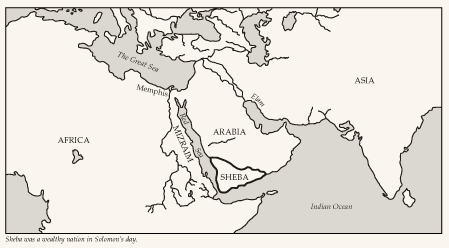
(1-41) 1 Kings x:1. Where Was the Queen of Sheba From?
Information technology is very likely that the woman was a Sabean from Arabia near the southern cease of the Cerise Bounding main (see Clarke, Commentary, 2:421). Three proofs are offered: (ane) the area in which the Sabeans lived is known to have abounded in riches and spices; (2) many ancient writers refer to the gold and silvery mines of Saba; and (3) the Sabeans had women rather than men for their rulers.
(ane-42) 1 Kings ten:xix. What Were the Stays Fastened to the Throne?
The description here indicates that the throne was similar to a round-topped, two-armed chair. The stays, or hands, were armrests on which the king could lean.
(1-43) ane Kings x:23–29. Solomon's Wealth
These verses sum up the tremendous wealth Solomon had amassed. Office of his wealth came through trading and international commerce, but much of information technology came through the economical oppression of the people.
(1-44) 1 Kings xi. Effect of Solomon's Sins
This chapter details the tragic fall of King Solomon. Although the Lord did non take Solomon's kingdom from him equally penalty, Solomon'due south disobedience resulted in his kingdom being divided at his death. Like Saul and David who preceded him, Solomon began his reign in favor with God and human being, but he soon let the power of the throne turn his heart away from God. Just as Saul's and David's had, Solomon's hope turned into tragedy (see Notes and Commentary on 1 Kings 3:five–28).
(one-45) 1 Kings 11:1–ten. What Can Nosotros Conclude Regarding Solomon's Many Marriages?
Solomon married "strange women," that is, strange women, or those not of the covenant. Solomon's marriages were for political expediency (see Notes and Commentary on 1 Kings iii:1) and possibly for personal reasons as well. But these women brought to State of israel their idols and heathen worship, which corrupted not only Solomon but the people also.
According to the Doctrine and Covenants, however, some of Solomon's wives were given to him of the Lord: "David likewise received many wives and concubines, and also Solomon and Moses my servants, equally also many others of my servants, from the beginning of creation until this fourth dimension; and in nothing did they sin salvage in those things which they received not of me" (D&C 132:38).
President Joseph Fielding Smith farther explained that the Lord "did not condemn Solomon and David for having wives which the Lord gave them.
"At present turn to [two Samuel] 12:vii–8 and you lot will find that the Lord gave David wives. In your reading of the Old Testament you will too find that Solomon was blest and the Lord appeared to him and gave him visions and great blessings when he had plural wives, but subsequently in his life, he took wives that the Lord did not give him." (Answers to Gospel Questions, 4:214.)
Jacob two:24–31clearly teaches that plural wives may be taken only when doing and so is authorized past the Lord. David'southward taking plural wives was authorized by the Lord, for David'southward wives "were given unto him of me [the Lord], by the hand of Nathan, my retainer, and others of the prophets who had the keys of this power" (D&C 132:39). No plural marriages are authorized past the Lord today, and any effort to justify them from ancient scripture will consequence in condemnation from the Lord.
(1-46) ane Kings 11:26–27. What Was the "Millo"?
Millo is "a place-name derived from the verb … 'to exist full', 'to fill'. … It was probably office of the fortification of [Jerusalem when it was a] Jebusite city, mayhap a solid tower ('full') or a breastwork 'filling' some weak indicate in the walls, for it was apparently already in existence in the time of David [2 Samuel 5:ix; 1 Chronicles eleven:8]. Information technology was rebuilt by Solomon ([see 1 Kings 9:15, 24; 11:27]; the 'alienation' hither referred to was probably a unlike matter) as part of his plan of strengthening the kingdom, and was again strengthened some two and a half centuries later when Hezekiah was preparing for the Assyrian invasion [come across 2 Chronicles 32:5]. This verse is taken by some to bespeak that Millo was some other name for the whole city of David, only information technology is more probable that it formed office of the defences of this, the s-eastern hill of later Jerusalem. Many theories have been put forrad every bit to what role of the urban center of David was strengthened by the Millo, but earthworks has not yet been sufficiently systematic to make identification possible." (Douglas, New Bible Dictionary, s.v. "Millo.")
(1-47) 1 Kings xi:eleven, 29–38. How Was the Israelite Kingdom to Exist Taken Away from the House of David and Solomon?
After Solomon had directly disobeyed the Lord by going later the gods of his pagan wives, the Lord told him that the kingdom would exist taken from him and given to ane of his servants (see 1 Kings eleven:xi). The servant was Jeroboam, whom Solomon had given dominance over Ephraim and Manasseh (run into v. 28). Jeroboam was told by the prophet Ahijah that he would rule over x of the tribes of State of israel. The tribe of Judah, however, was to continue under the reign of David's line so that the promise that the Messiah would come through the lineage of David and from the tribe of Judah would exist fulfilled (meet Genesis 49:10). The kingdom of Judah would include half the small tribe of Benjamin, the Levites, and the strangers that were in Judah's territory. At starting time, but part of Levi was with Judah, but after Jeroboam turned to idolatry, many more than deserted to Judah. Eventually a good share of the tribe of Levi was in the south. (see 2 Chronicles xv:9.)
Considering Ephraim and Manasseh, the ii sons of Joseph, were two tribes, counting Levi there were thirteen tribes at this time instead of twelve.
(1-48) 1 Kings 11:36. Hope Given to David
This verse reiterates the promise fabricated by the Lord to David that his kingdom would never become extinct while the globe should stand. The hope is fulfilled in Jesus Christ, a descendant of David.
See Notes and Commentary on Isaiah 11:one for a discussion of Christ'south holding the keys of David.
(one-49) one Kings 11:40. Who Is Shishak?
Run across Notes and Commentary on ane Kings 14:25.
Points to Ponder
(1-fifty) The Greatness and Tragedy of Solomon
Solomon's career began in as promising a mode equally anyone'south in the Old Testament. State of israel had finally reached the borders that were to exist hers, co-ordinate to the Lord's promise to Abraham, and the Lord had promised that peace would exist throughout Solomon's entire reign.
The Lord appeared to the young male monarch in a dream and asked, "What shall I give unto thee?" (run into 1 Kings three:5). Solomon, then humble and dedicated to the Lord, sought wisdom and was richly rewarded: "And God gave Solomon wisdom and understanding exceeding much, and largeness of heart, even as the sand that is on the bounding main shore. And Solomon's wisdom excelled the wisdom of all the children of the east country, and all the wisdom of Egypt." (one Kings 4:29–30.)
Elder Howard W. Hunter as well challenged us to obtain an understanding eye:
"If the Lord was pleased because of that which Solomon had asked of him, surely he would exist pleased with each of us if nosotros had the desire to acquire an agreement centre. This must come up from conscious endeavor coupled with organized religion and firm determination. An understanding heart results from the experiences we have in life if we keep the commandments of God. …
"… The ills of the globe would be cured by understanding. Wars would finish and law-breaking disappear. The scientific knowledge now being wasted in the world considering of the distrust of men and nations could be diverted to bless mankind. Atomic energy will destroy unless used for peaceful purposes by agreement hearts.
"We need more than understanding in our relationships with one some other, in business and in industry, between management and labor, between government and the governed. We need understanding in that most important of all social units, the family; understanding between children and parents and between husband and wife. Marriage would bring happiness, and divorce would be unknown if in that location were agreement hearts. Hatred tears downward, just understanding builds up.
"Our prayer could well be as was Solomon'south, 'Lord, requite me an agreement heart.'" (In Conference Report, Apr. 1962, pp. 75–76.)
What are the necessary steps given past Elder Hunter to obtain an agreement middle? What problems would be solved in the world if everyone would strive to have an understanding eye?
Solomon immune his honey for textile things and his great accomplishments as a builder to wean him from his early devotion to the Lord. Truthful, he accomplished great fame while the temple was being built, and his dedication of the house of the Lord was ane of his nearly spiritual moments; but later, when the Queen of Sheba and other foreign visitors paid their respects, they said little almost Solomon's righteousness or wisdom. Rather, they expressed amazement and awe at his tremendous achievements in building. Solomon appears to take grown hungry for the plaudits of men. He decided to construct fifty-fifty grander structures. To do and so, he enforced heavy taxation upon his people—so heavy that he eventually forced his people into poverty. Samuel's warnings near what would occur if Israel were governed by a king were fulfilled in every particular (encounter i Samuel viii:11–18). Mismanagement of the nation's wealth left united Israel tottering.
We all savor blessings from the Lord. If we are wise, nosotros volition accept the blessings with a grateful heart and walk in righteousness before the Lord.
Is affluence in the Church a problem today? Why? Practice we sometimes forget the instructions given by the Savior in Matthew 6:33?
We, as modern State of israel, need to avoid pride, misuse of wealth, and lust for the world'due south esteem—iii temptations that beset Solomon and led to his downfall. Are we whatever unlike? Even if nosotros brand some skillful decisions, could nosotros as well make some foolish ones that might destroy us?
Your patriarchal approving can be an important guide to you. Considering Solomon forgot his approval from the Lord, he lost it. To help you call up, yous might want to analyze your blessing past making a nautical chart every bit follows:
My Patriarchal Blessing
| Who Am I? | Promises | Admonitions |
|---|---|---|
| Statements almost you lot, your potential, your destiny, your relationship with God | Those things the Lord promises on status of your faithfulness | Counsel, warnings, and reminders to yous |
Source: https://www.churchofjesuschrist.org/study/manual/old-testament-student-manual-kings-malachi/chapter-1?lang=eng
0 Response to "what did king solomon do to make israel a strong and rich nation?"
Post a Comment